Jefferson County’s 2026 Test Results Are In — And What They Can’t Tell You About Your Child
Three03Lab Team · · 5 min read
Jefferson County Schools got its 2026 state assessment results on 12 August and published what they showed five days later.
There is genuinely good news in there. There is also one question the numbers cannot answer — the question most parents actually have, which is where is my own child, right now?
The district measured the right thing
Most districts publish proficiency as a photograph: what percentage of this year’s fourth graders met standard. It is the easy number, and it is close to useless — this year’s fourth graders are not last year’s fourth graders. Different children, different everything.
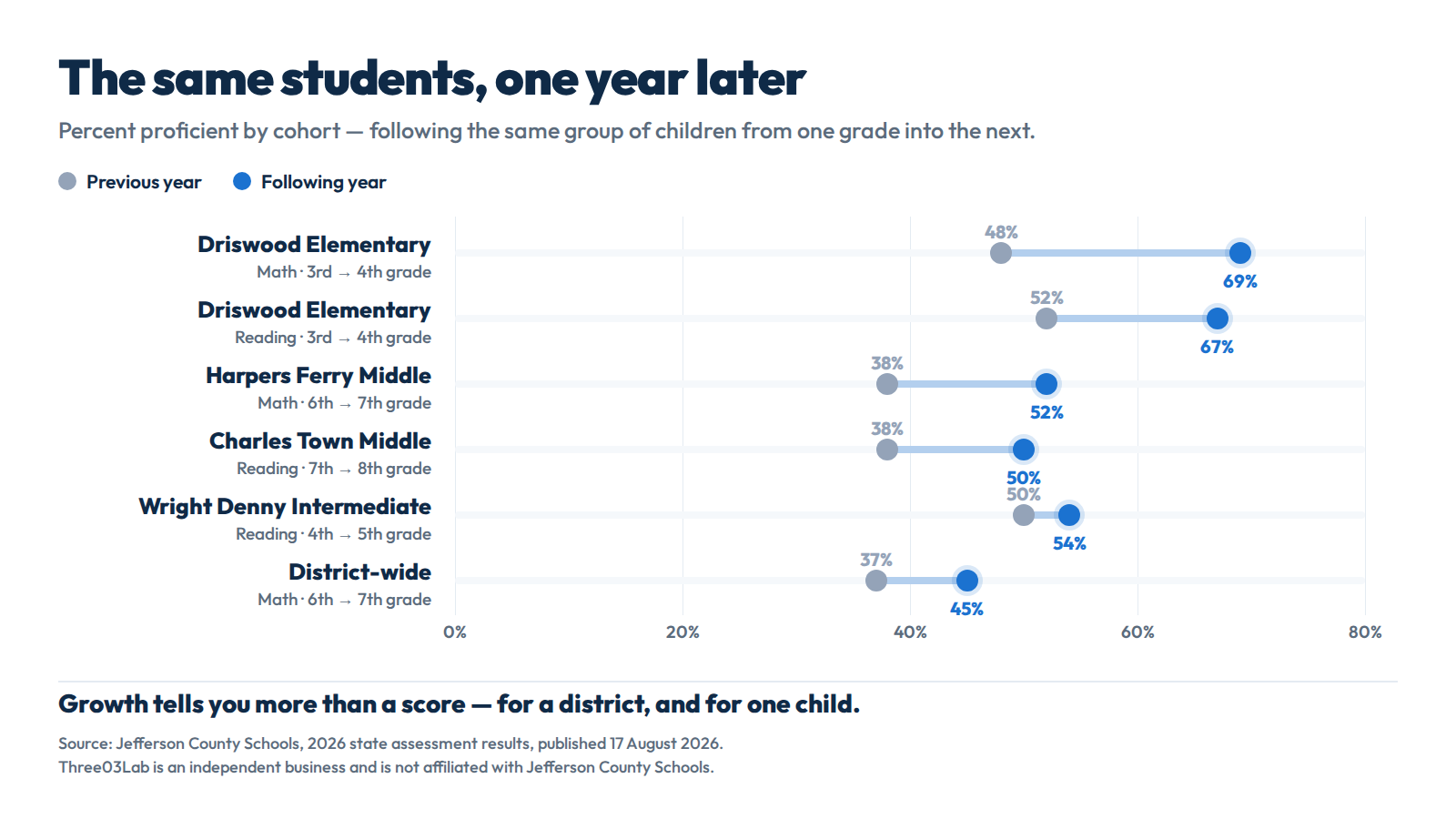
Jefferson County reported by cohort instead: the same students, followed from one grade into the next. That answers a much better question — did these particular children move?
What moved
| Cohort | Subject | Then | Now |
|---|---|---|---|
| Driswood Elementary, 3rd → 4th | Math | 48% | 69% |
| Driswood Elementary, 3rd → 4th | Reading | 52% | 67% |
| Harpers Ferry Middle, 6th → 7th | Math | 38% | 52% |
| Charles Town Middle, 7th → 8th | Reading | 38% | 50% |
| Wright Denny Intermediate, 4th → 5th | Reading | 50% | 54% |
| District-wide, 6th → 7th | Math | 37% | 45% |
A twenty-one point jump at Driswood in one year is not a rounding artifact. Neither is fourteen points at Harpers Ferry Middle, or twelve at Charles Town Middle. That is teachers finding something that works and doing more of it. The district also reported that its eleventh graders beat the state average in math, reading and science.
If your child is in one of those buildings, say so at the next conference. Teachers do not hear it enough.
Now the part it cannot do
Everything above is district-level. It is a true statement about groups of children.
It is not a statement about your child. The honest translation of a headline like this is: the cohort my kid belongs to moved up eight points. Which tells you almost nothing about whether your kid was one of the ones who moved.
That is not a criticism. No public accountability report is built to answer a question about one specific student. It is just worth naming, because it is easy to read a good headline and quietly conclude you have learned something about your own situation.
And then there’s the calendar
Your child sat the WVGSA in April or May. The district got results in mid-August. By the time anything reaches your hands it is September — new teacher, new grade, a summer in between.
So the most detailed thing the state produces about your child arrives about a third of a year late, describing a grade they have already left. Nobody’s fault: scoring and scaling an adaptive test statewide genuinely takes that long. But it means the state assessment is structurally a rear-view mirror. It is excellent at telling you where you have been. It was never built to tell you where you are.
“Grade level” isn’t one thing
Ask most parents what level their child is on and you get a grade number. Fifth grade. That is the only answer the system really offers.
But a real fifth grader in September might be:
- comfortably ahead on multiplication and division
- solidly on level for reading stories
- shaky on informational text — the paragraph-with-a-chart questions
- and quietly two years behind on fractions, which nobody has noticed because fractions haven’t come up much yet
That child has four different levels, and the only one ever written down is the number on the classroom door.
Underneath that sits the real issue. A fifth grader struggling with fifth-grade work is usually not stuck on fifth-grade work. The standards are a chain, and a gap two grades back keeps propagating upward while the class moves on without it. Nothing in the spring test packet goes looking backwards, because it is a snapshot of this year.
What we do about it
- An adaptive check-up in September, not next August. Built the way the WVGSA is built — questions get harder or easier as your child answers, organised around the same reporting categories, drawn from the West Virginia standards. One sitting, result the same day.
- A map, not a score. Which skills are solid, which aren’t, and — the part the state report structurally cannot do — which earlier standards underneath them are where the trouble actually starts.
- A roadmap, lowest gap first. The foundation gets repaired before the thing built on top of it. Or pick the topic yourself and assign a quiz directly.
- A progress report every week. Direction matters more than position — a child below level and climbing is in a completely different situation from a child at the same score who is flat, and one number cannot tell them apart.
What I’d do this month
- Read the district’s article. It is here. Find your child’s school.
- Dig out last spring’s report and go past the achievement level to the category table. That is where the information is.
- Turn it over. The growth graph is on the back and almost nobody looks at it.
- Get a current reading. September is the useful month for this — a gap found now has a whole school year to close in. The same gap found next August has run for another twelve months.
Find out where your child actually is
An adaptive check-up built on the West Virginia standards. One sitting, result the same day. Fourteen days free, no card required.
Three03Lab is math and ELA practice for grades 3–8, built on the West Virginia College- and Career-Readiness Standards, made by a parent here in Jefferson County.
Three03Lab is an independent business based in Ranson, West Virginia. We are not affiliated with, endorsed by, or connected to Jefferson County Schools or the West Virginia Department of Education. Congratulations to the teachers behind those numbers.
Frequently asked questions
When did Jefferson County Schools release its 2026 state assessment results?
The district received results on 12 August 2026 and published its summary of them on 17 August 2026.
What does “cohort growth” mean in school test results?
It means following the same group of students from one grade into the next and comparing how that group performed each year — rather than comparing this year’s fourth graders to last year’s fourth graders, who are a different set of children. Cohort comparisons show whether particular students progressed; snapshot comparisons cannot.
Which Jefferson County schools showed the biggest gains?
In math, Driswood Elementary’s third-to-fourth grade cohort rose from 48% to 69% proficient, and Harpers Ferry Middle’s sixth-to-seventh grade cohort rose from 38% to 52%. In reading, Driswood’s third-to-fourth grade cohort rose from 52% to 67%, and Charles Town Middle’s seventh-to-eighth grade cohort rose from 38% to 50%.
Why do state test results take so long to come back?
The WVGSA is computer-adaptive and scored with item response theory rather than raw percent correct, and results are scaled and validated statewide before release. Students sit the test in April and May; districts receive results in August. That means the report describes a grade your child has already finished.
Can the state report tell me exactly which skill my child is missing?
No. It reports at the level of broad categories such as Reading Informational Text, because an individual student answers too few questions per standard for a standard-level result to be statistically reliable. A separate diagnostic built for that purpose can check the prerequisite standards underneath the one where the difficulty appears.
How can I find out my child’s current level without waiting for the state test?
An adaptive diagnostic can be taken at any point in the year and returns a skill-level result the same sitting. Three03Lab’s check-up is organised around the same reporting categories the WVGSA uses, tests the prerequisite standards beneath each weak area, and builds a practice roadmap from what it finds.
Is Three03Lab affiliated with Jefferson County Schools?
No. Three03Lab is an independent business based in Ranson, West Virginia. It is not affiliated with, endorsed by, or connected to Jefferson County Schools or the West Virginia Department of Education.